Ants in a hamster cage, bird cage or rabbit hutch: what to do without chemicals near your pet
 KAI67 anti-ant pad, large 30x42 cm฿148 · 1 pad · Order via LINE or fill in the form
Order ฿148LINE @814ddrza
Swipe for the next topic · 17 topics
What causes ants in a hamster cage?
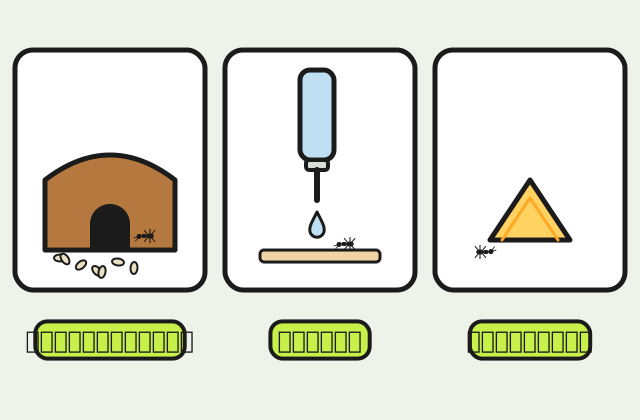
The biggest cause is food you cannot see. Hamsters stuff food into their cheek pouches and stash it in their house, under the bedding or in a corner. Sunflower seeds, grains, fruit and treats hidden for days give off a smell that leads ants in, even when the food dish you can see looks perfectly clean.
The second cause is moisture. A dripping water bottle, a bowl that keeps getting tipped over and the corner your pet uses as a toilet all make the bedding damp, giving ants water plus the smell of food mixed into it. Small pieces of fruit given as treats, such as apple or banana, draw a lot of ants if they stay in the cage for hours.
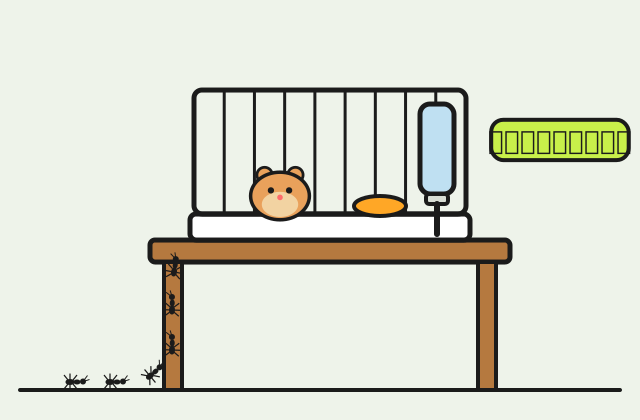
The third cause is where the cage stands. A cage against a wall, by a window or touched by a hanging curtain lets ants walk straight in along the wall. The table holding the cage also becomes a route if a cable or a food bag leans on it. An open bag of pet food left beside the cage pulls the ant trail even closer.
Are ants dangerous to hamsters and other small pets?
Some ants bite or sting, and a small animal in a cage cannot escape the way a free-roaming animal can. Young, sick or sleeping animals buried in their bedding are at more risk than a healthy adult. Treat ants in the cage as something to deal with that same day, not something to wait and see about.
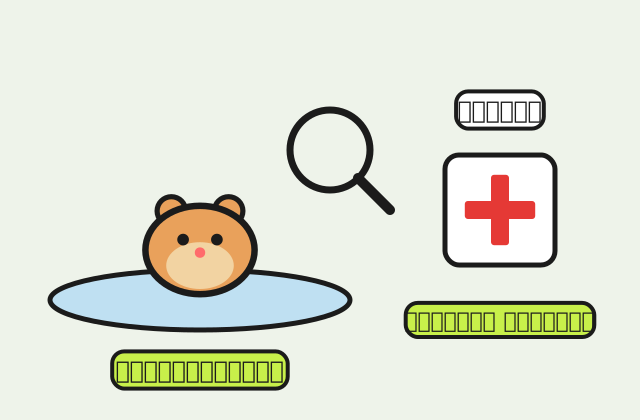
Once your pet is out of the cage, check whether any ants are clinging to it, especially around the eyes, ears, nose and belly. If you see any, brush them off gently with a soft brush or your finger. Do not wipe your pet with any cleaning product or alcohol, and keep an eye on it for the rest of the day.
If your pet scratches a lot, has red skin, wounds, seems lethargic, stops eating or breathes oddly, take it to a vet who treats that species. This article gives no advice on medicines or treatment, because small animals are very sensitive to drugs and chemicals, and home remedies passed around online can be more dangerous than the ant bites themselves.
What should you do first about ants in a hamster cage?
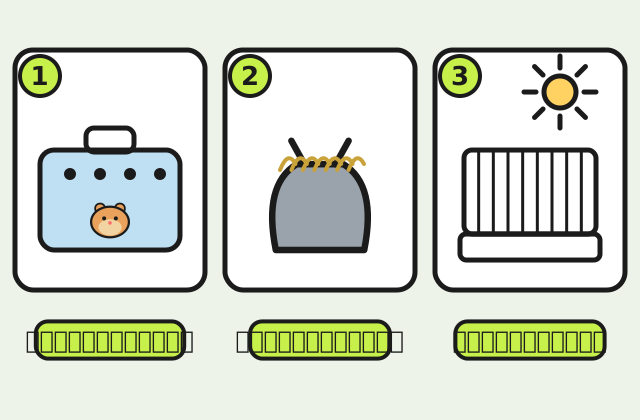
Always move your pet out first. Use a clean carrier or travel cage with air holes, fresh bedding and water. Then tip the food, bedding and anything in the house that ants reached into a bag, tie it and take it outside. Do not keep food that ants walked through for your pet to eat later.
Wash the cage, base tray, food dish, water bottle and toys with plain water or water with a little dish soap, then rinse with plain water until there is no foam and no soap smell. Let everything dry completely before adding new bedding. Meanwhile wipe the table or floor where the cage stands with a cloth and soapy water to remove the scent trail ants left behind.
Before putting the cage back, work out where the ants came from: the wall, the window ledge, a table leg or a cable. If you are not sure yet, set the cage up somewhere else for now and watch the old spot for another day or two. How to follow an ant trail back to its source in the home is explained in ants in the house.
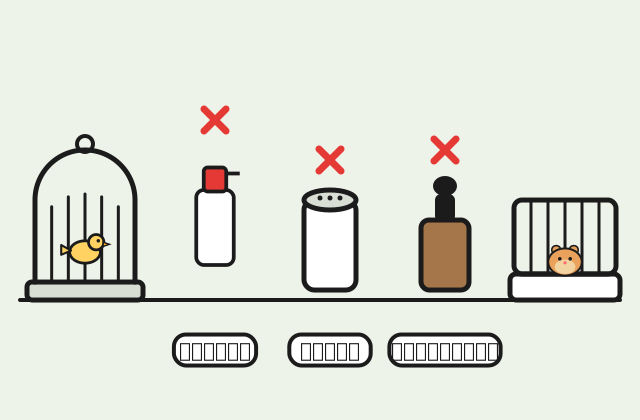
Can you spray or dust ant powder around the cage?
No. The animal in the cage is there all the time, breathing in mist and smells, walking over powder and licking its fur afterwards. A small body takes in an effective dose far more easily than a person does. Birds in particular have airways that are very sensitive to fumes and strong smells, so nothing should be sprayed or dusted for ants in the room with the cage.
Natural remedies are not automatically safe either. Essential oils, spice powders and vinegar sprayed near the cage can irritate the animal, and chalk or powder laid around the cage sticks to paws and fur when your pet comes out to play. If you must use any product in a home with small pets, ask your vet first and follow the label strictly.
Safer is removing what draws the ants, which is food scraps and damp, then blocking the route with distance and tools that need no spraying, such as a table that does not touch the wall and food kept on an anti-ant pad outside the cage. What the pad is made of and what we are still waiting for from the manufacturer is in is an anti-ant pad safe.
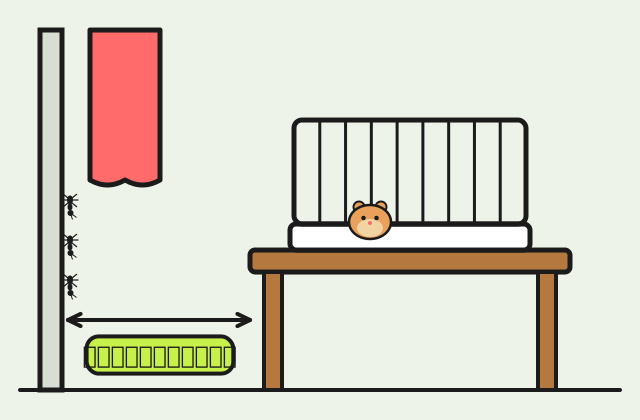
Where should you put the cage to keep ants out of a hamster cage?
Stand the cage on a table or shelf that does not touch a wall or window, with no curtain, cable or food bag leaning against it. Ants mostly walk along edges. If no side of the table connects to the wall, the only way up is a table leg, which is much easier for you to check and block.
Pick a room with good airflow, not too hot and out of direct sun, as care guides for that species recommend, and away from the kitchen, bins and pot plants, since all three are places ants already like. If the cage has to be near the kitchen, keep the kitchen bin under closer control using the steps in ants in the trash.
If you use water trays under the table legs as moats, change the water often so mosquitoes cannot breed in it, and make sure a pet out for playtime cannot fall in. If you paint anti-ant gel around the table legs, only do it where your pet cannot reach or climb past, because the seller has not yet supplied an ingredient list for the gel.
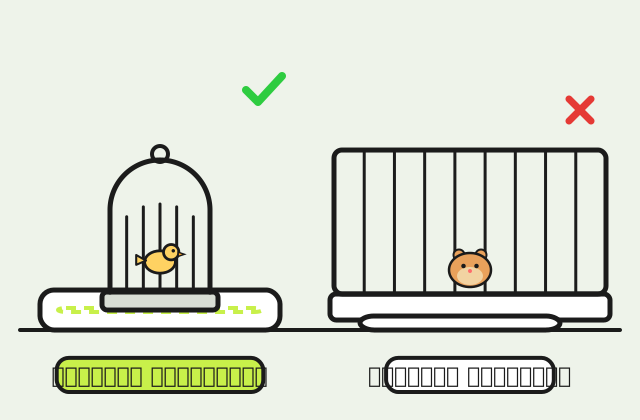
Can you put an anti-ant pad under a hamster or bird cage?
Yes, if the cage is small enough to sit in the middle of the pad with at least 5 cm to every edge, as the manufacturer recommends. The product page lists use under hamster cages and bird cages. A 30x42 cm pad therefore suits a cage or box with a base up to about 20x32 cm, while the 24x32 cm pad is better for a single food dish kept outside the cage.
Most hamster cages of the size care guides recommend have a base larger than the pad. In that case, use the table-away-from-the-wall approach instead and put the pad under food kept outside the cage, such as the food box and seed bag. If ants reach the table, they meet the food on the pad first and stop at the edge. See the size at anti-ant pad 24x32 cm.
Do not put the pad inside the cage where a rodent can chew it, and do not let your pet lick it regularly, as the manufacturer has not yet sent us documents on the surface coating. Always keep the pad outside the cage and wipe off spilled food or seeds every day, because anything on the pad acts as a bridge for ants to cross the edge.
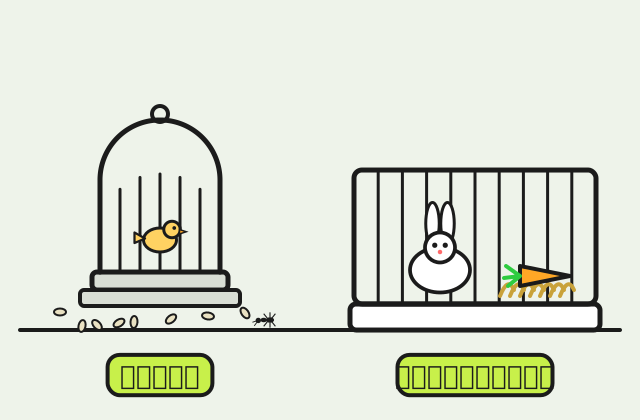
How are bird cages and rabbit hutches different from hamster cages?
Bird cages scatter seeds and husks outside the cage every day, along with fruit and soft food given as extras. All of this lands on the floor or table around the cage, so ants usually find the mess around the cage before they ever reach the food cup. A tray or cloth under the cage, emptied and wiped every day, helps a lot. Feeding portions, seed storage and outdoor feeders are covered in ants in bird food.
Rabbit cages are usually large and on the floor, with hay, pellets, vegetables and fruit. Large amounts of urine make the corners damp, and ants walking on the floor reach a floor cage more easily than one on a table. Remove leftover vegetables and fruit the same day, change the toilet-corner bedding often and leave space between the cage and the wall so you can see the floor around it.
Animals that eat mostly nectar or fruit, such as sugar gliders, draw more ants than pellet eaters because their food is high in sugar. Use dishes that come out for washing, offer small portions and remove leftovers when your vet or an experienced keeper advises. Other small rodents, such as dormice, follow the same approach as hamsters.
How do you stop ants coming back to the cage?
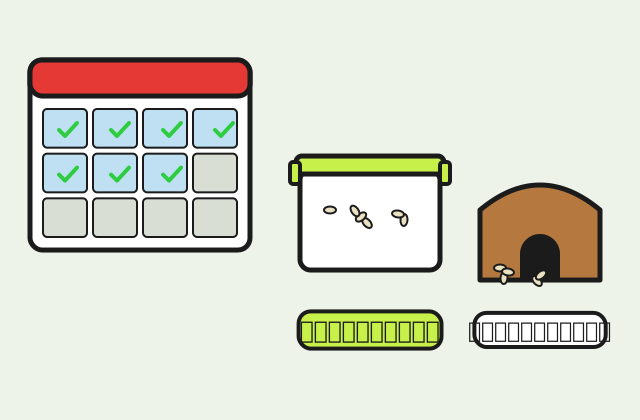
Make three things a routine: remove leftover fruit and fresh food the same day, check hidden food stashes in the house and corners now and then without tearing everything apart daily and stressing your pet, and keep opened bags of pet food in a box with a tight lid. Those three alone remove almost everything that draws ants.
Change bedding on the schedule that suits your species, and change damp corners more often. Wipe the table and floor around the cage daily with a damp cloth and check the water bottle does not drip. If it does, replace the spout or the bottle, because a daily drip is what keeps the bedding damp and brings ants back.
If you still find ants in a hamster cage or walking in that room every day after all this, there is a nest near the room, so fix it at the source: seal cracks, clean the kitchen and deal with other pets’ bowls. If you also have a dog, big bowls and outdoor feeding are covered in ants in dog food.
What causes ants in bird food?
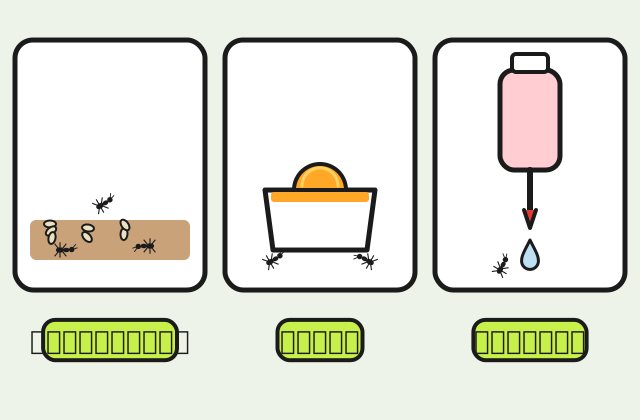
Ants in bird food usually start with nectar and fruit. Nectar feeders for sunbirds and other nectar-eating birds attract ants very quickly if sugar water seeps out at the tip of the tube. Cut fruit such as banana, papaya and watermelon put out in a cage or on an outdoor tray gives off a strong sweet smell when left in hot weather.
The second cause is spilled and broken seed. Birds often flick seed out of the tray to pick out the ones they like, so seed and husks fall onto the ground under the feeder or into the cage tray. Broken seed and the starchy dust from it are easy for ants to carry back to the nest. If the ground under the feeder is soil or lawn, ants from nests in the soil are already close by.
The third cause is supplements with protein or fat, such as egg food for chicks, dried mealworms and pellets for some species, plus water cups with food dropped in them. If these are topped up in large amounts and left for days, they become a regular food source that ants learn the way to.
How do outdoor bird feeders and cage food cups differ?
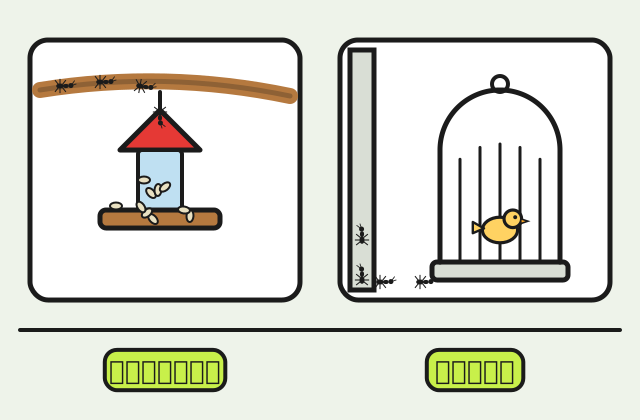
An outdoor feeder sits in ant territory already. Ants come from nests in the soil, in trees or in pots around the house, and you cannot control the source, so the focus is on cutting the last stretch of the route, meaning the cord, hook or pole the feeder hangs from, and clearing spilled seed underneath. Trying to rid the whole garden of ants is not the goal.
A cage food cup is indoors, and ants reaching it usually walk along walls, table legs or the cage stand from a nest in the house or from outside. Here you have more control: you can move the cage, wipe the ant trail and raise or isolate the cage so ants cannot climb up. Cage placement and other small pets in cages are covered in ants in a hamster cage, bird cage or rabbit hutch.
The birds differ too. Birds at an outdoor feeder are wild or city birds that can fly away, while a caged bird cannot escape. If many ants get into a cage, a pet bird is more stressed and disturbed, especially chicks or sick birds that move little. So deal with ants in the cage as soon as you see them.
How do you keep ants off a hanging bird feeder?
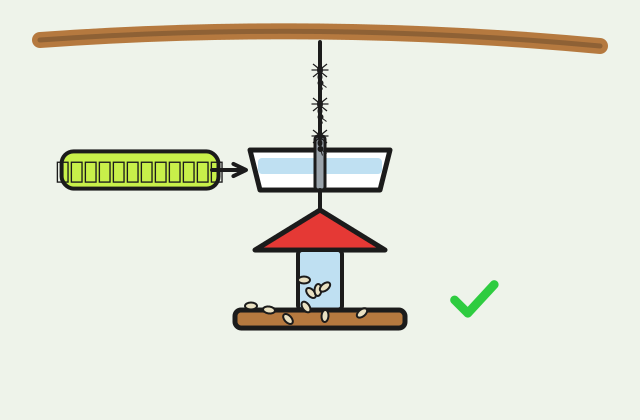
The popular method is an ant moat, a small cup of water hung between the hook and the feeder, with a central post the cord or hook passes through without leaking. Ants walking down the cord meet water all around and cannot cross. There are ready-made ones for nectar feeders and home-made versions from bottle caps or plastic cups.
After that, keep water in the cup at all times, especially in hot weather when it evaporates fast, and scoop out leaves or insects that fall in. A leaf bridging the rim lets ants walk across. The cup should be open at the top so you can see the water, and not so deep that a small bird could fall in.
Besides the moat, hang the feeder clear of branches, leaves and walls, because ants do not have to use the cord. They can walk straight from a leaf touching the feeder. If you hang it from a balcony rail, use a cord or chain long enough to keep the feeder away from the rail, and move it if ants find a new way.
Can you put grease or petroleum jelly on the feeder pole, or spray it?
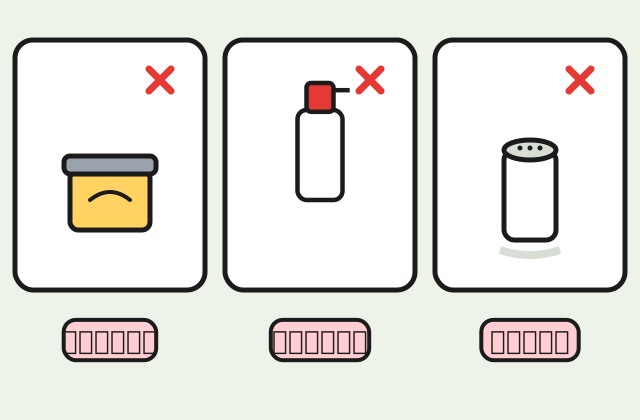
Not recommended. Grease, petroleum jelly and oil smeared on poles or cords to trap ants can get onto the feathers of birds that perch on or brush past them. Oiled feathers clump and lose their condition, which is why many bird care organisations advise against this method and suggest an ant moat or better hanging placement instead.
Insect sprays, ant powders and insecticide chalk should not be used on or near feeders, seed trays or water cups, because birds peck on the ground and on trays and may eat seed mixed with the chemical. If you need to treat an ant nest elsewhere in the garden, use a registered product, follow the label and keep it well away from where birds feed.
If you suspect a pet bird has touched or eaten an insecticide, or it shows unusual signs such as lethargy, not eating or difficulty breathing, contact a vet who treats birds as soon as possible and bring the product label. We cannot say which substances are safe for birds or in what amounts.
How should you manage cage food cups to avoid ants?
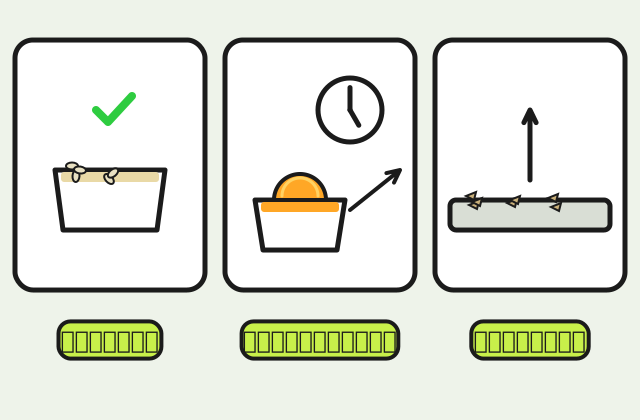
Fill the seed cup with only what the bird eats in a day instead of topping it up for several days. An overfilled cup is where ants in bird food show up most, because seed that spills over lands in the cage tray and feeds the ants. Each morning, blow or tip the husks off the top of the cup and refill it. This also helps you see whether the bird is eating normally.
Put fruit and fresh food in a separate cup and remove it once the bird has finished, rather than leaving it all day. The right time depends on the species and the weather, so if unsure, ask a vet or a breeder experienced with that species. Wash the fruit cup daily, because dried fruit juice on the cup draws ants even with no fruit left.
Empty husks and spilled seed from the cage tray every day, wipe it dry and change the paper liner if you use one. Change water that has food in it daily. For a tube drinker that drips, wipe around the spout and check where it drips, because water collecting under the cage is a spot ants love.
How do you store seed and bird food so ants cannot get in?
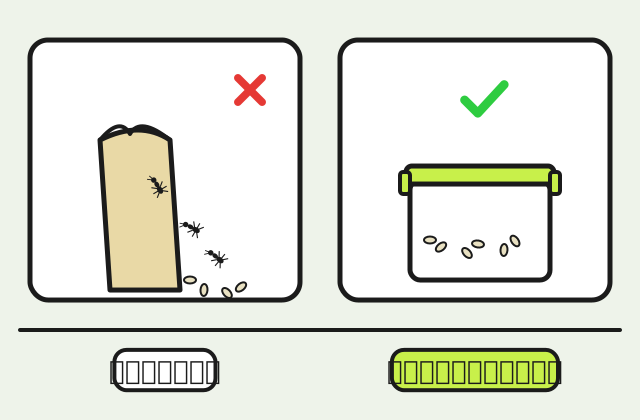
An opened seed bag with its top just folded over is easy for ants to get into. Move the seed into a plastic box or jar with a tight lid, or a locking lid with a rubber seal, and keep it somewhere dry, not on the floor or against a wall with an ant trail. Scoop out only what you need each day and close the lid every time.
Before pouring new seed into the box, check the old seed has no ants, small insects or musty smell. If lots of ants have got into the seed, some people spread it on a tray in the sun to let them leave, but if the seed is damp, mouldy or has other insects in it, throw it away and buy new, because spoiled seed is bad for birds.
Egg food, dried mealworms and pellets contain more fat and protein than seed, so they draw ants more strongly. Keep them in separate sealed containers and follow the storage instructions on the label; some need refrigerating once opened. If you have several kinds of pet food at home, the same storage rules apply to dog food too, see ants in dog food.
Can you use an anti-ant pad to stop ants in bird food?
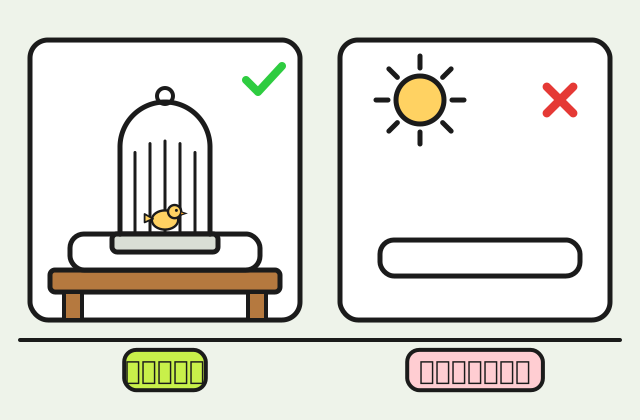
Yes, for a small cage standing on a table or shelf indoors. Put the cage in the middle of the pad with at least 5 cm between the cage base and every edge, as the manufacturer recommends. A 30x42 cm pad therefore takes a cage base of up to about 20x32 cm; a bigger cage will not work. Size and price are on the 30x42 cm anti-ant pad page.
Watch out for husks the bird flicks out of the cage landing on the pad. If husks or seed pile up to the edge, ants can use them to cross. Wipe the pad daily when you empty the tray, and do not let a cage cover hang down to touch the table outside the pad, because a hanging cloth is a bridge ants can climb.
For outdoor feeding, the pad only suits a seed tray on a table in the shade, because the manufacturer advises avoiding strong sun and damp, so it is not for trays out in the sun and rain. Use an ant moat for hanging feeders instead. Do not apply anti-ant gel to poles or perches birds can land on, because the seller has no confirmed data on its safety for birds.
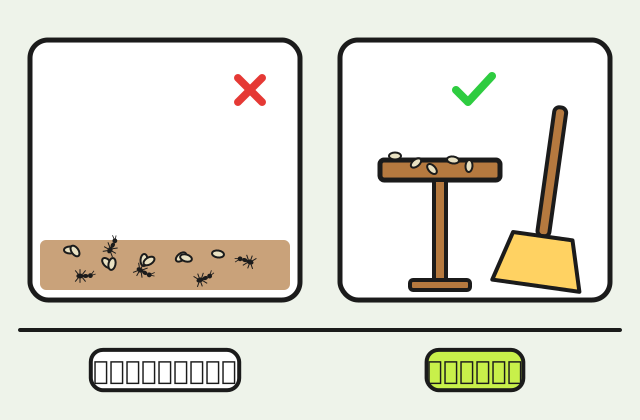
How do you stop ants in bird food when feeding on the ground or a garden tray?
Scattering seed on soil or lawn gives ants immediate access to bird food, because many ant nests are already in the soil. Switch to a raised tray, for example on a stand or a garden table, and put out only as much as the birds will finish in the morning or evening session, instead of a large pile left all day.
Every evening, sweep up seed and husks around the tray or under the feeder and put them in a lidded bin. If the ground under the feeder is concrete, hose it down from time to time. If it is soil, move the feeding spot now and then so seed does not build up in one place, which draws both ants and rats.
If the garden has trees or pots with lines of ants and aphids, they may be the source of the ants reaching your feeder. How to check and deal with ants in pots without harming the plants is in ants in potted plants. Tackling the source clearly reduces the number of ants reaching your feeders.
Frequently asked questions about ants in pet cages
My hamster was bitten by ants. What should I do?
Move it out of the cage into a clean carrier, gently brush any ants off and watch its skin and behaviour. If you see wounds or swelling, or it scratches a lot, seems lethargic or stops eating, take it to a vet who treats small animals. Do not apply creams or wipe it with any product yourself, because it will lick it off.
Can my hamster still eat food that ants got into?
No. Throw away the food in the dish and everything stashed in the house that ants reached. Food in a sealed bag or box that ants did not get into is fine, but wipe the outside of the packaging before moving it into a new lidded box.
Can I draw ant chalk around the cage?
It is not recommended. Ant chalk contains insecticide, and the powder rubs off onto hands, paws and fur. A pet out for playtime or a bird perching nearby could easily touch it. Keep the cage away from the wall and protect food with a pad outside the cage instead.
Can I put water trays under the legs of the table holding the cage?
Yes, as long as no other part of the table touches the wall or nearby objects, otherwise ants find another way up. Change the water often so mosquitoes cannot breed and keep it topped up. Dust or leaves floating in the tray can form a bridge for ants.
What should I do about ants in a bird cage?
Put a tray under the cage and empty and wipe it daily, remove leftover fruit and soft food the same day, keep the cage away from walls and plants, and never spray or use strong smells in a room with birds, because they are very sensitive to fumes. If the cage is small enough to sit on an anti-ant pad with a 5 cm margin, a pad works too.
Can I put ant bait near the cage?
It should never be anywhere a pet can reach, whether in the cage or during playtime. If you need bait in the home, place it only where pets truly cannot get to it, follow the label and ask your vet first if you are unsure.
Ants are on my sunbird nectar feeder. What should I do?
Hang an ant moat above the nectar bottle, wipe the spout and bottle whenever sugar water drips, check the bottle does not leak, and hang it clear of branches and leaves. If ants have fallen into the nectar, pour it away, wash the bottle and refill it.
Can birds still eat food that ants got into?
If there are only a few ants on top of a seed cup, many people pick them off and carry on, but fruit, egg food and fresh food with ants on it should be thrown away, because it may already be spoiling. If the bird shows unusual signs after eating, consult a vet.
Are ants dangerous to pet birds?
Most ants do not harm a healthy bird straight away, but they disturb it, especially chicks, nesting birds and sick birds that cannot get away. If ants are swarming a bird or the bird has a wound, move it away from the spot and consult a vet rather than treating it yourself.
Can I use ant chalk or powder around the bird cage?
Not recommended, because these products contain chemicals. A bird may peck at husks that fell into the powder, or step in it and swallow some while preening. Keep the cage away from the wall, wipe the ant trail and stand the cage on an anti-ant pad instead.
There is an ant nest under the garden feeder. Do I need to destroy it?
Not necessarily. It is easier to move the feeder to another spot on concrete or away from the nest and sweep up spilled seed every day, so ants have no reason to visit often. If the nest is so close to the house that it is a problem, consult a pest control provider who plans treatment away from where birds feed.
Does an ant moat work on every type of bird feeder?
It works on hanging feeders where a single cord, chain or hook is the only way in. Pole-mounted feeders need a moat that fits around the pole. Trays on tables or wall-mounted feeders cannot use a water cup, so rely on sweeping up spills and good placement.